
The Meditative Architect: Doubt, Consciousness and Design in Software Architecture through the Thought of Allan Wallace
R. Adams
11/7/2025
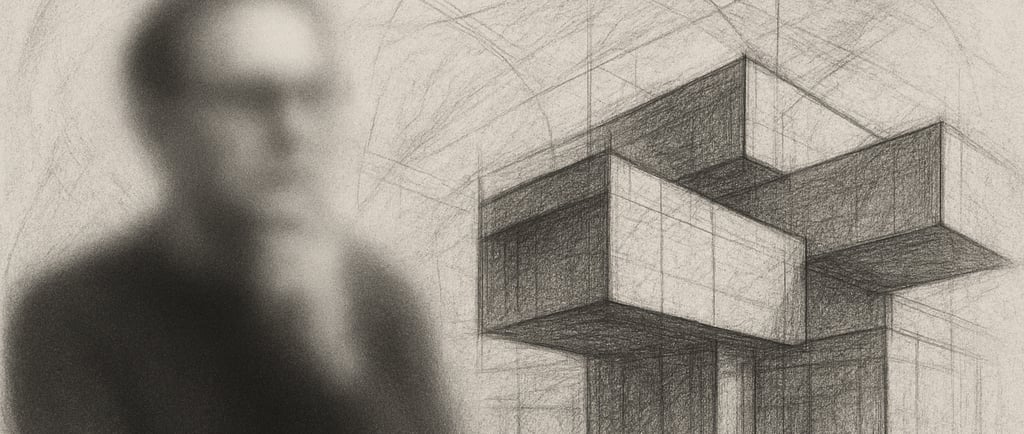
I remember reading Allan Wallace one afternoon, while studying physics, as my mind drifted between equations and silence. I was struck by the way he spoke of the mind as if it were a laboratory. Years later, when I began working in software architecture, I realized that his ideas had left an unexpected resonance: building, too, can be a form of applied meditation—a practice that begins with observation, not imposition.
There are thinkers who cross boundaries without asking permission. Wallace is one of them: a physicist trained under Stephen Hawking, a former Buddhist monk, and a translator of Tibetan texts. His thought acts as a bridge between empirical science and inner contemplation. His proposal is as simple as it is radical: to study consciousness with the same rigor we use to study the universe.
And within that idea lies something that deeply resonates with software architecture. The architect is not outside the system they design; they are part of it. Every technical decision reflects a mental state, a way of perceiving reality and organizing chaos.
Doubt as Method
At the heart of both contemplative practice and scientific inquiry lies a constant: doubt. Not as negation, but as precision. Wallace describes doubt as a fertile pause, a moment in which the mind observes without projecting.
In software architecture, that attitude is vital. Every technological choice, from design patterns to database models, is tinted by our biases and prior certainties. When we stop doubting, we start programming on autopilot.
To doubt doesn’t mean to be ignorant; it means to recognize that knowledge is always partial. That humility allows us to re-evaluate decisions as system conditions evolve. In architectural design, it’s the difference between building a sandcastle or a living structure that adapts to its environment.
In essence, doubt functions like discrete logic: assigning values with full awareness that the context may change. A stable architecture doesn’t arise from certainty, but from a balance between truth and contingency.
Perception and Models
Wallace holds that reality is never perceived directly, the mind models it. In engineering, the parallel is clear. A diagram, an API, or a domain model is not the system’s reality but a representation shaped by our understanding.
The question is not whether the model is correct, but whether it is useful. Its usefulness depends on context, observer, and the relationships it establishes. Designing an architecture resembles meditation: observing patterns, identifying causes, and reducing suffering, in this case, technical debt.
Each point of view, from business to security, projects its own version of reality. The architect becomes a translator among these perspectives. The goal is not to impose a single vision, but to harmonize diversity without losing coherence.
The Architect as Quantum Observer
In quantum physics, the observer alters the experiment. In architecture, design alters the perception of the system. Nothing fully exists until it is defined.
The architect, like the scientist, collapses possibilities with every decision. Each interface, each dependency, each pipeline configures how the system “thinks” and communicates. That’s why designing software is also a way of creating reality.
Understanding this changes perspective: it’s no longer only about efficiency or performance, but about structural awareness. The architect doesn’t just design flows; they design emergent behaviors.
Unity and Multiplicity
Modern physics reminds us that matter is not made of things, but of relationships. Likewise, contemporary architectures are ecologies of services—distributed systems where coherence emerges from the balance between independence and communication.
An architect who understands this stops thinking in isolated components and starts thinking in interactions. What matters is not the microservice, but the flow that connects it; not the class, but the message.
Wallace would call this interdependence: every phenomenon arises conditioned by others. In software, this means observing how local decisions affect global behavior. Designing, then, becomes an ethical act as much as a technical one—each line of code alters an ecosystem.
AI and System Consciousness
In times when artificial intelligence learns without understanding, Wallace’s lesson regains its strength. He reminds us that consciousness is not mere processing, it is presence.
Perhaps the next architectural revolution will not come from machines that think faster, but from systems that can observe themselves. The architecture of the future will not only be scalable or resilient, it will be reflective.
Imagine engines that evaluate their own decisions, adjusting their structure like living organisms. Wallace might say that such technical self-awareness marks the beginning of a collective mind, a step toward the integration of reason and digital introspection.
Beyond Duality
Wallace’s vision invites us to transcend categories: subject and object, mind and matter, developer and system. From that lens, the architect is not a demiurge imposing order, but a participating observer.
From that arises a nearly meditative principle: the more aware the observer, the more stable the system becomes. Not by mysticism, but because mental clarity improves technical decision-making. Attentive thought reduces architectural entropy.
Epilogue: The Art of Seeing
Allan Wallace’s greatest legacy may be reminding us that knowledge does not belong to any single discipline, but to an attitude toward the world. Science brings method; contemplation brings vision. Architecture needs both, rigor to build, and awareness to preserve purpose.
To doubt, to observe, to understand, three verbs that define both a scientist and an architect. At that intersection, between bits and mind, between patterns and silence, architecture ceases to be mere technique and becomes a way of understanding.
R. Adams
Cybersecurity & Architecture
Exploring the future of technology, security, and digital design.
Contact
© 2025. All rights reserved.
info@securitychronicles.tech